
📈 Investing Notice: This content is for informational purposes only and not investment advice. Investments can go up and down in value. Always do your own research and seek advice from a regulated professional. See full disclaimer. Table of Contents
Capital Gains Tax (CGT) often catches people off guard, especially when selling a second property, shares, crypto, or other investments. Many assume Tax only applies to income, only to realise after a sale that Capital Gains Tax may be due.
This guide explains how Capital Gains Tax works in the UK, what you might owe, and how to estimate your position before you sell. You’ll also find a Capital Gains Tax calculator below to help you estimate your potential tax bill based on your situation.
What Is Capital Gains Tax in the UK?
Capital Gains Tax is a tax you may need to pay when you sell or dispose of an asset that has increased in value since you acquired it.
You are taxed on the gain, not the total sale price. In simple terms:
Capital gain = Sale price – Purchase price – Allowable costs
CGT differs from Income Tax and applies only when specific types of assets are sold or otherwise disposed of.
When Do You Pay Capital Gains Tax?
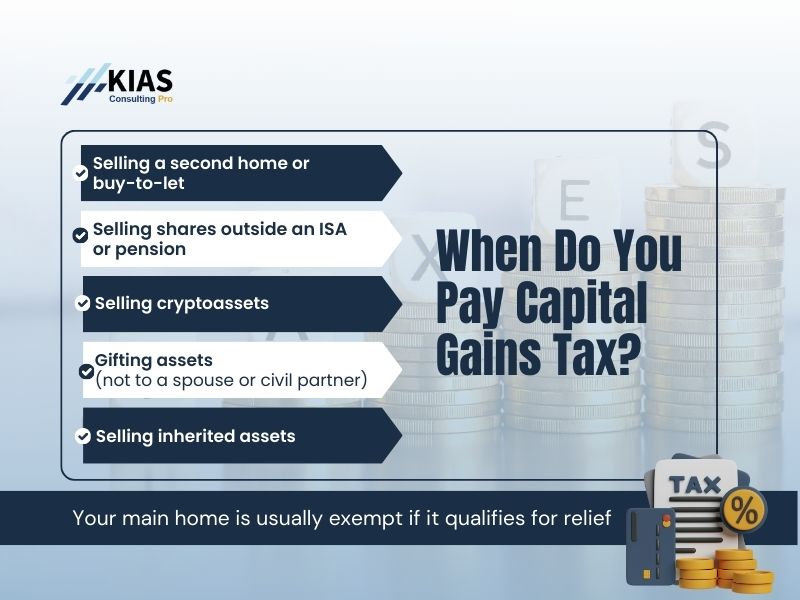
You may need to pay Capital Gains Tax when you:
- Sell a second home or buy-to-let property
- Sell shares that are not held in an ISA or pension
- Sell cryptoassets
- Gift assets to someone other than your spouse or civil partner
- Dispose of inherited assets (CGT applies on sale, not inheritance itself)
CGT does not usually apply when you sell your main home, provided it qualifies for Private Residence Relief.
Capital Gains Tax Allowance (UK-2025/26)
Each tax year, individuals receive a Capital Gains Tax allowance, the amount of gains you can make before CGT applies.
For the 2025/26 tax year, the CGT annual allowance is £3,000 per person
Key points:
- The allowance applies per person
- It cannot be carried forward
- Married couples and civil partners can plan by transferring assets between them
If your total gains exceed the allowance, CGT is payable on the excess.
Capital Gains Tax Rates in the UK (2025/26)
The rate of Capital Gains Tax you pay depends on:
- Your income tax band
- The type of asset sold
Typical CGT rates for individuals (most situations)
For most chargeable assets (including shares and crypto) and residential property that is not your main home, the main CGT rates are:
- 18% (lower rate)
- 24% (higher rate)
This means your estimated CGT will mainly depend on whether you’re a basic-rate taxpayer or higher/additional-rate taxpayer in that tax year.
Note: Carried interest is treated differently and can be taxed at different rates (commonly referenced as 32%).
Typical CGT rates:
- Shares, crypto, and other assets
- Basic rate taxpayer: lower CGT rate
- Higher or additional rate taxpayer: higher CGT rate
- Residential property (not your main home)
- Higher CGT rates apply compared to other assets
Because rates differ, understanding your income position and the asset type is crucial before selling, as it directly impacts your CGT liability.
Capital Gains Tax Rates in the UK
Use the calculator below to estimate how much Capital Gains Tax you might need to pay based on:
- The asset sold
- Your income tax band
- Purchase and sale prices
- Allowable costs
- The annual CGT allowance
🧾 Capital Gains Tax Calculator (UK 2025/26)
Gain before allowance: —
Allowance applied: —
Taxable gain: —
Estimated CGT payable: —
—
📌 Detailed Breakdown
| Step | Amount |
|---|---|
| Sale proceeds | — |
| Less purchase cost | — |
| Less allowable costs | — |
| Gain before allowance | — |
| Less annual allowance | — |
| Taxable gain | — |
| Estimated CGT | — |
Understanding the CGT Rate Alignment (30 October 2024)
On 30 October 2024, the government changed CGT rates so that (in most cases) shares/crypto/other assets use the same main rate structure as residential property. For 2025/26, the main CGT rates most people will use are 18% (lower) and 24% (higher).
Before 30 Oct 2024 (general guide)
- Shares/Crypto: 10% (basic) / 20% (higher)
- Residential property: 18% (basic) / 28% (higher)
From 30 Oct 2024 onwards (main rates)
- Most assets: 18% (basic) / 24% (higher/additional)
- Note: Special cases exist (for example, carried interest).
What this means in plain English
- Shares/crypto sold from 30 Oct 2024 are typically taxed at higher rates than before.
- Residential property sold from 30 Oct 2024 uses a 24% higher rate (previously 28% before that date).
- Always check your disposal date — rates depend on when the asset was sold.
⚠️ Critical: The 60-Day Property Reporting Deadline
If you sell UK residential property and CGT is due, you must:
- Report the sale to HMRC within 60 days of completion
- Pay the CGT due within the same 60 days
This commonly affects:
- Second homes
- Buy-to-let properties
- Former main homes that do not qualify for full relief
If you miss the deadline
- Penalties can apply
- Interest may be charged on late payment
This 60-day rule applies for completion dates on/after 27 October 2021. If you are unsure, check HMRC guidance or seek professional support.
📊 Example: CGT Calculation for 2025/26
Scenario: Sarah sells a buy-to-let flat
- Sale price: £250,000
- Purchase price: £180,000
- Solicitor/agent fees: £6,500
- Tax band: Higher rate
- Annual allowance (2025/26): £3,000
Step-by-step
- Gain = £250,000 − £180,000 − £6,500 = £63,500
- Taxable gain = £63,500 − £3,000 = £60,500
- CGT (24%) = £60,500 × 24% = £14,520
⏰ Property reminder: If CGT is due, Sarah must report and pay within 60 days of completion.
👆 Scroll back up to use the Capital Gains Tax calculator above.
Note: This calculator provides an estimate for educational purposes only. Actual CGT liability may differ based on reliefs, losses, and HMRC rules.
⚠️ Critical: The 60-Day Property Reporting Deadline
If you sell UK residential property and Capital Gains Tax is due, you must usually:
1 Report the sale to HMRC within 60 days of completion, and
2 Pay any CGT due within the same 60-day window.
This commonly applies to:
- Second homes
- Buy-to-let properties
- Properties that don’t qualify for full Private Residence Relief
This is separate from your Self Assessment return, and missing the deadline can lead to penalties and interest.
How Capital Gains Tax Is Calculated (Step by Step)
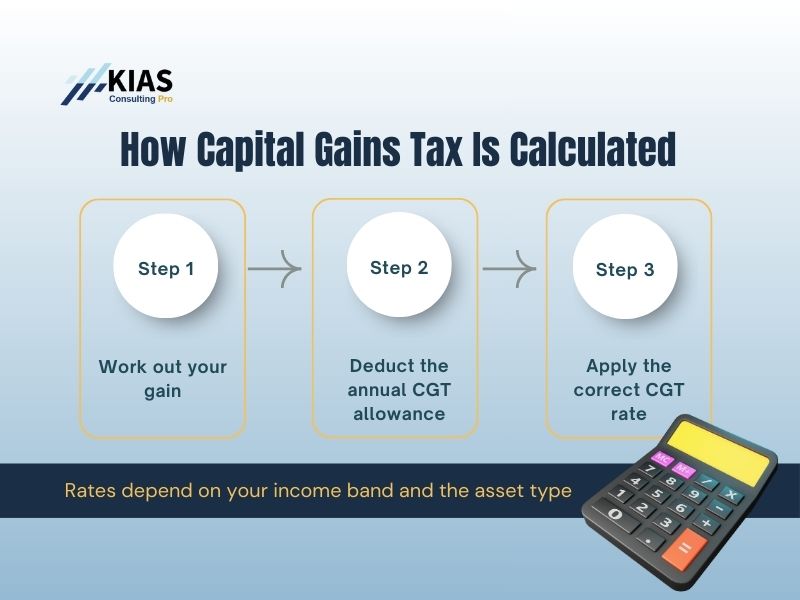
Here’s how CGT is typically worked out:
1 Work out your gain.
Sale proceeds minus purchase cost and allowable expenses.2 Deduct the CGT allowance.
If your gain exceeds the allowance, the excess becomes taxable.3 Apply the correct CGT rate.
Based on your income tax band and the asset type.This is the logic used in the calculator above.
Capital Gains Tax on Property in the UK
Capital Gains Tax on property most commonly applies when selling:
- A second home
- A buy-to-let
- A former main residence that does not fully qualify for relief
Important points:
- Your main home may qualify for Private Residence Relief
- Property disposals may have specific reporting and payment deadlines (see the 60-day rule above)
- CGT on property is a common area where people underestimate their liability
If property is involved, it’s essential to estimate CGT before selling.
Capital Gains Tax on Shares and Investments
If you sell shares or investments held outside an ISA or pension:
- Capital Gains Tax may apply
- Dividends and CGT are taxed separately
- Using tax-efficient wrappers like ISAs can significantly reduce future CGT exposure
You can learn more about how ISAs support long-term, tax-free wealth building in this guide:
👉 The Smart Investor’s Secret: ISA Tax-Free Wealth in the UK
👉 Are Stocks and Shares ISAs Worth It?
This is why long-term planning matters, not just the sale itself.
Common Capital Gains Tax Mistakes to Avoid
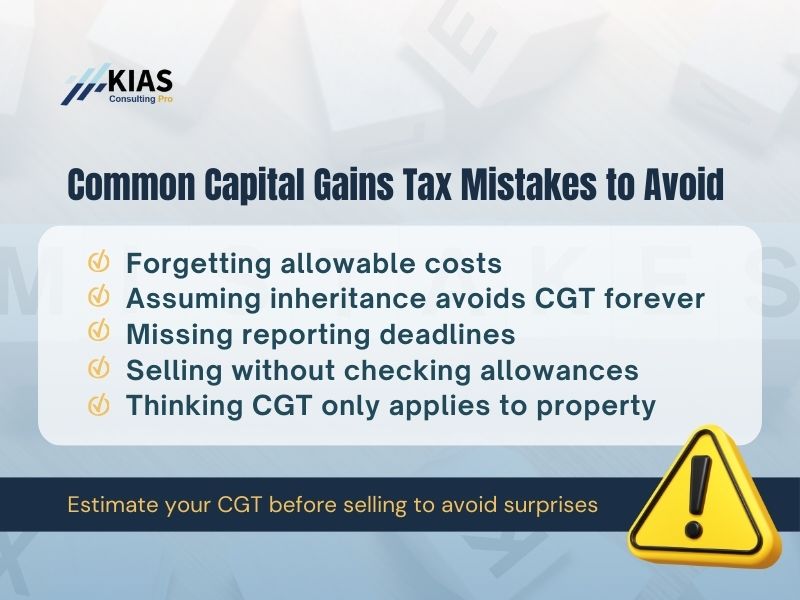
Many people run into issues by:
- Forgetting to deduct allowable costs
- Assuming inheritance means no CGT forever.
- Missing reporting deadlines.
- Selling assets without checking allowances first.
- Believing CGT only applies to property.
A simple estimate before selling can help you feel more confident and prevent expensive surprises, giving you peace of mind about your financial planning.
Do You Need to Report Capital Gains to HMRC?
You usually need to report Capital Gains Tax if:
- Your total gains exceed the annual allowance
- You sell residential property and CGT is due (often within 60 days)
- You are required to complete a Self Assessment return
Checking early whether you need to report Capital Gains Tax and understanding deadlines is essential to ensure compliance and avoid penalties.

Q: Do I pay Capital Gains Tax if I reinvest the money?
Reinvesting the proceeds does not automatically remove CGT liability. The original gain may still be taxable.
Q: Do spouses pay CGT when transferring assets?
Transfers between spouses or civil partners are usually exempt, which can create planning opportunities.
Q: Is Capital Gains Tax different for crypto?
Cryptoassets are treated similarly to other investments for CGT purposes, but record-keeping is crucial.
Q: What if I make a loss?
Losses may be offset against gains or carried forward under HMRC rules.
Key Takeaways
- Capital Gains Tax applies more widely than many people expect
- The annual CGT allowance for 2025/26 is £3,000 per person
- Most CGT rates for individuals are 18% / 24% (depending on your tax band)
- If CGT is due on a UK residential property sale, you may need to report and pay within 60 days
- Estimating CGT before selling can help you plan and avoid surprises
Use the Capital Gains Tax calculator above early in your planning process to estimate your potential tax bill and avoid surprises when selling assets.

This content is for educational purposes only and does not constitute Tax or financial advice. Tax rules can change, and individual circumstances vary. Always refer to official HMRC guidance or seek professional support where needed.

Get the Budget Planner